Anticipated 70-acre master plan visual
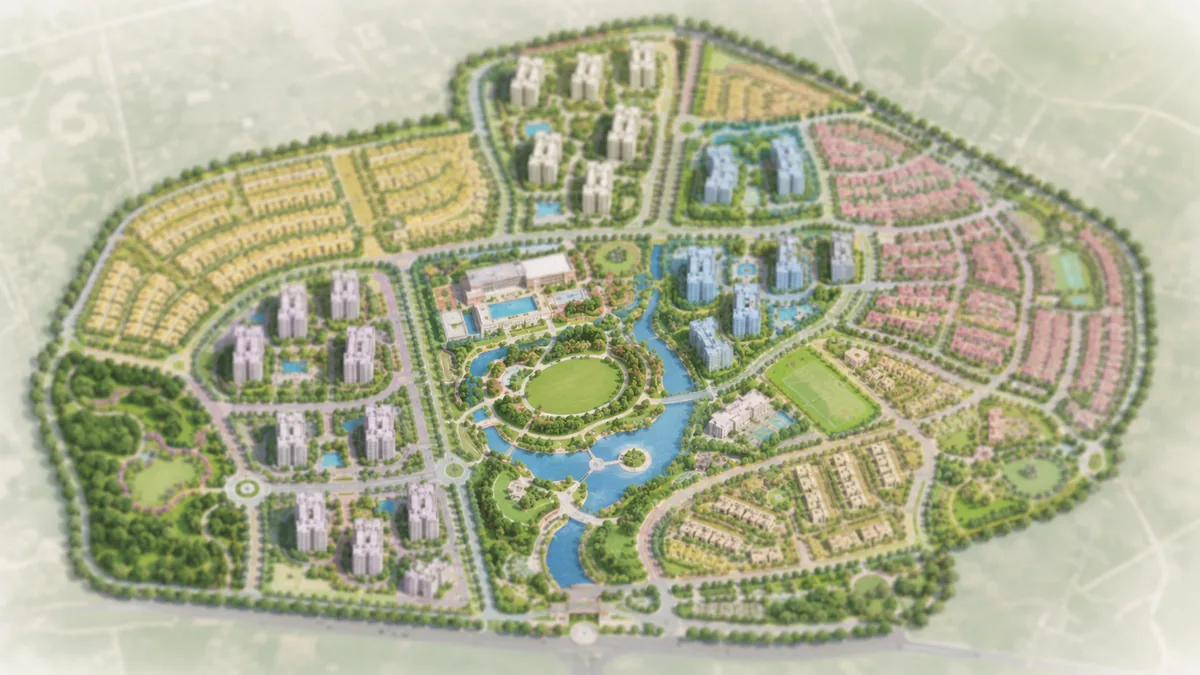
Lodha Hoskote master plan: the 70-acre canvas
The defining feature of the master plan is its scale. A 70+ acre parcel is uncommon in the Hoskote micro-market, where most residential supply arrives in far smaller footprints. That scale is what makes a true township possible: it allows the built form to be concentrated in tall, well-spaced towers on a generous green podium, freeing the ground plane for landscape, sports precincts, theme-park zones and the signature clubhouse. From a planning angle, Lodha Sadahalli keeps the reference local: internal roads, open-space placement, amenity access, and tower orientation all affect how the address will live after handover.
Lodha's township philosophy, proven at scale in its Mumbai developments, is built around this idea: maximise open space and amenity density by going vertical on the built form. The result is a community that feels expansive at ground level despite a high-rise skyline — a design signature that separates a Lodha township from a conventional apartment cluster.
| Master-plan attribute | Anticipated approach |
|---|---|
| Land area | 70+ acres |
| Built form | Iconic master-planned high-rise towers |
| Density strategy | Tall, well-spaced towers on a green podium — maximised ground-level open space |
| Tower / floor count | To be confirmed at launch (not asserted as fact) |
| Configurations | Anticipated 3, 3.5 & 4 BHK |
| Clubhouse | Signature multi-tier, anticipated 45,000+ sq ft |
| Open space | Extensive landscaped spine, theme parks, reflexology tracks |
| Sustainability | STP, rainwater harvesting, organic waste converter, solar-assisted lighting, EV provision |
Anticipated township structure
A 70-acre Lodha township is anticipated to follow a clear organising logic — the same logic that has worked across the group's large communities:
Why high-rise on a 70-acre parcel
A reasonable question is why Lodha would build high-rise towers rather than low-rise blocks or villas on a 70-acre parcel. The answer is the township logic itself. A high-rise format concentrates the built footprint, which frees the maximum possible ground area for landscape, amenity and open space — the very things that make a township a destination rather than a housing estate. On a large parcel, this trade is decisive: tall, well-spaced towers on a green podium can deliver both a substantial number of premium homes and an expansive, generous ground plane, whereas a low-rise layout would consume most of the parcel in built footprint and driveways, leaving little of the open space that defines the Lodha experience. The high-rise format also delivers the skyline aspect, cross-ventilation and privacy that the community's senior-professional and elite-investor buyers value, and it suits the corridor's premium positioning. It is the format that lets a 70-acre parcel become a landmark rather than a subdivision.
The signature clubhouse precinct
The centrepiece of the Lodha Hoskote master plan is its signature multi-tier clubhouse, anticipated at 45,000+ sq ft. This is not a single gym-and-hall block; at 45,000+ sq ft it is a lifestyle destination in its own right, anticipated to be programmed across multiple tiers with five-star amenities, sports courts and co-working lounges.
A clubhouse of this scale is anticipated to house indoor sports (badminton, squash, a basketball or multi-purpose court), a fully-equipped gymnasium and fitness studio, a spa and wellness suite with sauna and steam, a yoga and meditation deck, indoor games rooms, a mini theatre, a library, a multipurpose banquet hall, and — reflecting the corridor's professional buyer base — a co-working lounge and business centre. The clubhouse opens onto the resort-style pool deck and the central landscape, tying the indoor and outdoor amenity programmes together. For a corridor whose public 'third places' — cafés, co-working, premium leisure — are still building, a 45,000+ sq ft clubhouse internalises much of that lifestyle layer within the community.
Open space, landscape and the Lodha-signature ecosystem
Beyond the clubhouse, the master plan is anticipated to devote extensive ground-level area to a Lodha-signature township ecosystem of landscape and lifestyle programming:
This programming is what turns a 70-acre parcel into a destination community. The extensive open space is also the master plan's biggest defence against the corridor's still-maturing public realm — residents get a full landscape and lifestyle environment inside the perimeter.
The open-space strategy in context
For a buyer, the open-space strategy is not an abstraction — it is what daily life feels like inside the community. On a 70-acre township with a high-rise built form, the anticipated ground plane is generous enough that a resident can walk from tower to clubhouse to pool to sports court along a landscaped spine without crossing a parking lot or a service road. Children can move between play zones and the amphitheatre within a secured, car-light environment. Elders have their own plaza and reflexology loops. And the theme-park zones give the community distinct outdoor 'rooms' — a feature that separates a Lodha township's landscape from the generic lawns of a conventional gated project. This programmed, layered open space is the single most tangible benefit of the township scale, and it is the reason a large branded community delivers a lifestyle that a standalone tower on a small plot cannot match. In an emerging corridor, where the surrounding public realm is still building, that internal landscape is also the community's daily environment — the parks, the walking loops and the gathering spaces that residents would otherwise look to a mature neighbourhood to provide.
Connectivity within the master plan
Beyond the amenity and landscape layers, a township master plan of this scale must solve internal movement — and the anticipated approach reflects Lodha's township standard. Internal roads are anticipated to separate resident and service traffic, with drop-offs at each tower cluster and structured basement or multi-level parking keeping the ground plane car-light. Pedestrian and cycling networks are anticipated to thread the landscape spine, connecting the towers, the clubhouse and the amenity clusters on a walkable, safe route. A secured perimeter with managed, boom-barrier access controls entry, and the wider corridor connectivity — NH-75 frontage, and the future PRR and metro links — ties the community into the East Bengaluru road and transit grid. The combination of car-light internal movement and strong external connectivity is what makes a large township both liveable inside and well-connected outside.
Sustainability infrastructure
At township scale, sustainability infrastructure is anticipated to be built in rather than bolted on:
These systems lower the community's running costs and environmental footprint, and reflect the standard Lodha township specification in its recent Bengaluru and MMR developments.
Anticipated phasing
A 70-acre township of this scale is typically released in phases, and Lodha Hoskote is currently at its Phase 1 EOI stage. The anticipated phasing logic — again, derived from Lodha's township approach, not published fact — would place early phases and the arrival landscape near the main entry for faster visual progress and a strong first impression, position the signature clubhouse and active-sports zone centrally for marketing and community impact, and release later phases after price discovery in the first launch. Phased release is also what creates the pre-launch pricing opportunity: Phase 1 EOI buyers enter ahead of the tier escalation that typically accompanies later phases and the public launch.
Importantly, each phase of a township is typically a separately RERA-registered project. Lodha Hoskote's Phase 1 RERA registration is awaited and will be published at or before formal launch; this microsite does not assert a specific tower or unit count as fact and does not carry any RERA number until the developer registers the project.
Master-plan summary
Lodha Hoskote's master plan is the direct expression of its 70+ acre scale: iconic high-rise towers concentrated on a green podium, freeing the ground plane for an extensive landscaped ecosystem, a signature 45,000+ sq ft multi-tier clubhouse, sports precincts, theme parks and reflexology tracks — all designed at township level and defended by a secured, managed perimeter. It is the master plan of a self-contained destination community, drawn from the township playbook Lodha has proven at scale in Mumbai, and it is the reason the project can create its own environment in a corridor still maturing around it. The exact tower, floor and unit counts, the phase-wise RERA registrations, and the final landscape drawings will be confirmed on the official launch documentation; everything on this page is the anticipated master-plan logic, framed as confident anticipation ahead of that release. The floor-plans and amenities pages detail the residences and the amenity inventory within this framework.
Lodha Hoskote FAQ
What is Lodha Hoskote?
Lodha Hoskote is Lodha Group's (Macrotech Developers Limited) new pre-launch residential township on the Hoskote–Whitefield extension corridor of East Bengaluru, off NH-75 (Old Madras Road). It is planned across a 70+ acre master development of iconic high-rise towers, offering anticipated 3, 3.5 & 4 BHK luxury residences, a signature multi-tier clubhouse anticipated at 45,000+ sq ft, and a Lodha-signature township ecosystem.
Who is developing Lodha Hoskote?
Lodha Group, the consumer brand of Macrotech Developers Limited — one of India's largest listed residential developers, headquartered in Mumbai, listed on the BSE and NSE since its 2021 IPO, with 85+ million sq ft delivered. Lodha Hoskote is the group's entry into the Hoskote–Whitefield extension corridor of East Bengaluru.
Where is Lodha Hoskote located?
On the Hoskote–Whitefield extension corridor of East Bengaluru, off NH-75 (Old Madras Road). The location gives access to the Whitefield / ITPL tech belt (approximately 12–15 km), KR Puram (approximately 9–15 km), the upcoming Peripheral Ring Road, and the airport corridor.
What is the price of Lodha Hoskote?
Indicative pre-launch pricing starts from approximately ₹1.90 Crore for a 3 BHK, ₹2.30 Crore for a 3.5 BHK, and ₹2.75 Crore for a 4 BHK. These figures are indicative and derived from Lodha's premium-segment standards in comparable Bengaluru corridors — not an official cost sheet. Final pricing is confirmed at formal launch.
What configurations are available at Lodha Hoskote?
Anticipated 3, 3.5 & 4 BHK luxury residences with expansive layouts, aimed at senior corporate professionals and elite investors. Exact carpet areas, tower counts and unit counts will be confirmed on the official launch documentation.
Is Lodha Hoskote RERA registered?
RERA registration for Lodha Hoskote is awaited. For a pre-launch / EOI-stage project this is expected — Karnataka RERA (K-RERA) registration typically lands at or just before formal launch. No RERA number has been assigned or fabricated for this project; it will be published once the developer completes registration.
Contact Lodha Hoskote to register your Phase 1 EOI
Request the latest pricing, the cost sheet, floor plates, the RERA-registration update and a site-visit slot — and secure priority access at pre-launch pricing ahead of the public launch.
Contact us